The Kidney Project: Bringing Patient Voices to Life Through Participatory Arts
Our Journey
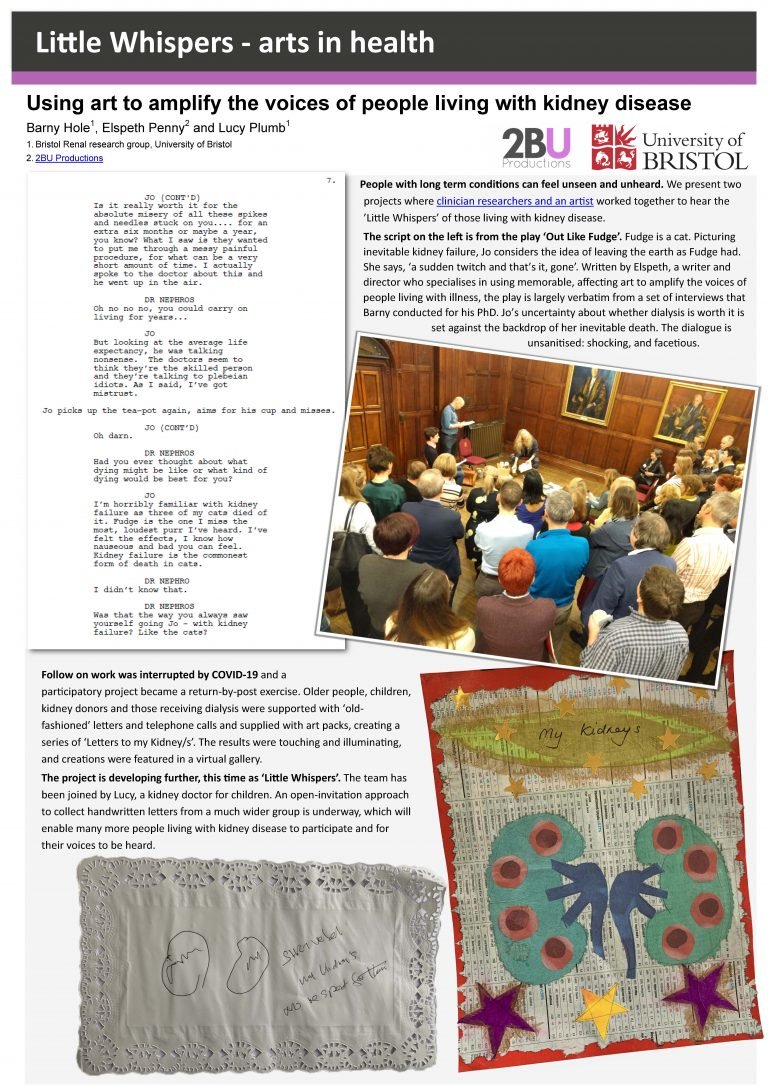
The kidney project began with a simple hunch from clinician and PhD researcher Barny Hole of Bristol University: that drama might offer a powerful approach to public engagement around end-stage kidney disease and dialysis decisions. Through word-of-mouth recommendation, Barny connected with theatre-maker Elspeth Penny, and together they embarked on a unique collaboration to bring patient voices into clinical and public spaces.
Out Like Fudge: Hard-Hitting Truth Through Performance
In autumn 2019, Elspeth Penny wrote two short plays based on kidney patients’ experiences. “Out Like Fudge” emerged from verbatim interviews that Barny had recorded and transcribed as part of his PhD research. The play centers on Jo, a character who reflects on the sudden death of their pet, Fudge, and expresses a desire to leave life in a similar way—quickly and without prolonged suffering.
From the start, we agreed on two principles: humor was important, even if dark, and we would stay true to the people in the interviews while protecting their identities through careful fictionalization.
Reception and Impact
When “Out Like Fudge” premiered at the #dialysisbalance conference at Bristol’s Wills Building in December 2019, the response was powerful. Conference attendees described it as “hard-hitting” and noted how the revelation that all words came from real people facing end-stage kidney disease decisions was particularly impactful.
Feedback included:
- “Very involved. Has left a significant mark on me as to how many patients must feel when they are told dialysis is required”
- “So powerful”
- “I’m a GP… it was thought provoking, challenging of traditional approaches both in care but also conference content. I really valued that”
The play enabled both Patient and Public Involvement (PPI) groups and clinicians to reflect on medical procedures from the patient’s perspective—a crucial shift in perspective.
International Recognition
The impact of “Out Like Fudge” reached beyond the UK. Jeanette Finderup, a Clinical Nurse Specialist and PhD from Denmark, saw the performance and was moved to have it translated for her own conference. In November 2021, the play was performed in Danish under the title “Ikke mere udenomsnak” (roughly: “No more talking around the subject”).
Barny presented an hour-long lecture titled “Hvad må det koste at leve længere for en patient i dialyse?” (“How much will a patient in dialysis pay to live longer?”), with Elspeth Penny providing an introduction to the play.
Letter to My Kidney: A Participatory Arts Project
Building on this success, 2BU Productions developed the work further with “Letter to My Kidney,” a participatory project commissioned by Futures2020 and funded by the European Commission.
The Approach
In a world dominated by Zoom during 2020, we deliberately chose old-fashioned communication methods—phone calls and letter writing—to create intimate connections with participants. Working with clinician/researcher Barny Hole, we engaged with diverse groups including older people, children, kidney donors, patients on dialysis, and clinicians.
The Creative Process
We started simply, asking participants to write a letter. As they grew comfortable with the idea, we sent art packs to help them create a series of creative “Letters to My Kidney/s.” The results were both touching and illuminating, offering unique insights into the lived experience of kidney disease.
The project was exhibited through Futures2020 in December 2020, reaching nearly 500,000 viewers and providing a moving testament to patient voices and experiences.
Our Team
This work has been a collaboration between:
- Barny Hole – Kidney doctor and researcher, University of Bristol
- Elspeth Penny – Theatre-maker, writer, and director, 2BU Productions
- Lucy Plumb – Children’s kidney consultant and researcher, University of Bristol
The Impact
Through theatre and participatory arts, we’ve created spaces for:
- Patient voices to be heard authentically in clinical settings
- Healthcare professionals to experience patient perspectives in visceral, memorable ways
- Public engagement with complex medical and ethical decisions
- International dialogue about end-of-life care and patient autonomy
Evolution: Little Whispers and Beyond
The kidney project work has continued to evolve and expand, with the participatory letter-writing approach developing into interconnected projects that amplify patient voices and democratize health through public art.
Whispers in the Archive
In 2024/25, the kidney project work evolved into “Whispers in the Archive,” receiving Seedcorn funding from the University of Bristol’s Brigstow Institute. Building on the success of “Letter to My Kidney” (which reached nearly 500,000 viewers), this project brings together the original team with the University of Bristol Theatre Collection to explore new dimensions of arts and health practice.
The Questions
This research project asks vital questions: How do people living with chronic kidney disease want to tell their stories? Who do they want to share their stories with? How do they want their stories told?
The Challenge
Chronic kidney disease affects more than 1.8 million diagnosed people in England, with approximately another million undiagnosed. Up to 1 in 4 people may be affected across their lifetime. Yet it remains an “invisible disease”—symptoms may not appear until kidney function is severely reduced, and public awareness is very low. To alter the course of this epidemic, raising awareness and sharing lived experiences is vital.
Four Core Aims
- Build on “Letter to My Kidney” – continuing participatory arts work gathering personal experiences of kidney disease
- Learn from the Welfare State International archive – discovering how this pioneering performance company (1968-2006) approached health in community arts
- Pilot creative workshops – working WITH people with kidney disease to develop ‘little whispers’ from unheard voices
- Explore transformation – finding ways to turn sensitive illness narratives into engaging public art
The Approach
The project combines archival research with participatory arts practice:
Archival Research – Working with the University of Bristol Theatre Collection to examine Welfare State International (WSI) materials that explored arts in community healthcare settings, creating a guide for how the archive can support participatory health projects.
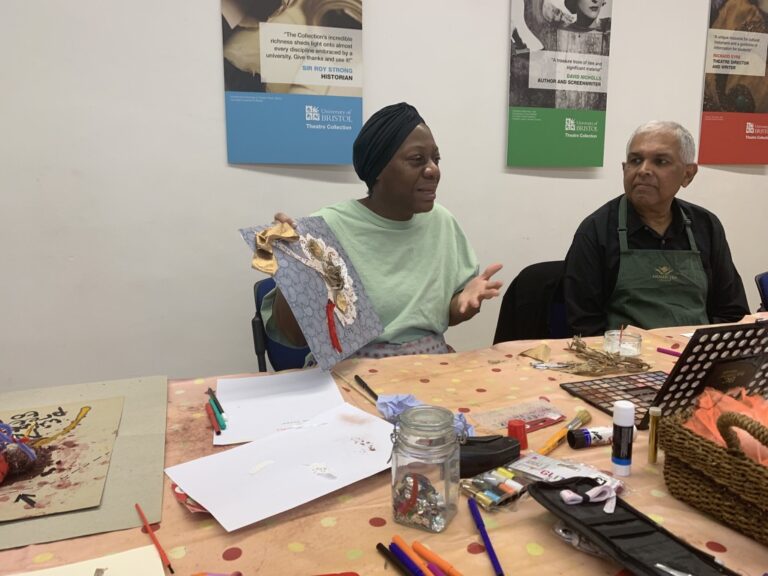
Participant Workshops – Inviting people from diverse backgrounds living with chronic kidney disease to share their experiences through creative workshops and co-produce further activities.
Co-Design Process – Sharing archival discoveries with participants to help them imagine how they want their stories told, who should hear them, and in what formats.
Exhibition and Dissemination – Creating a mini mobile pop-up exhibition and producing academic papers to showcase the work.
The Workshop Process
The project involves co-produced workshops where patients, doctors, and artists work together as equals. This isn’t about extracting data—it’s genuine co-creation. The participatory methodology, developed over 10 years across multiple projects, uses creative approaches to enable people to share their experiences in ways that feel meaningful to them. This creates space for metaphor and indirect expression of difficult experiences, bridging the private and public while giving people agency over their own narratives.
The workshop process incorporates rich materials from the Welfare State International archive, which proved surprisingly generative for contemporary practice. The archive gave the team permission to be ambitious, playful, and bold—it’s not just about preservation, but inspiration for future work.
More information about this project can be found at:
- https://brigstow-institute.blogs.bristol.ac.uk/whispers-in-the-archive/
- https://www.bristol.ac.uk/brigstow/research/projects/20242025/whispers-from-the-archive.html
Creating Resources for Others
The team is developing a source guide about the Welfare State International archive for other artists working in arts and health, helping others navigate this practice and learn from WSI’s approach to large-scale community work.
Looking Ahead
The team aspires to create a reflective piece of artwork that will make the invisible visible, bringing patient voices and experiences into public spaces.
Elspeth Penny is acting as creative advisor for the 2026 Community Kidney Day (CKD-HIT day), as part of World Kidney Day celebrations in collaboration with NHS Bristol, North Somerset and South Gloucestershire Bristol Health Partners Kidney Disease Health Integration Team (of which Barny Hole and Lucy Plumb are co-directors). This event will use educational and creative activities to share kidney disease stories and experiences with ethnically diverse communities in the region—groups at especially high risk of kidney disease and its negative outcomes.
The research team hopes to develop this work into a larger funded project, with plans for legacy work including more workshops, further research and documentation, written outputs, and wider dissemination across arts and health sectors.
The Team
- Elspeth Penny (2BU Productions Ltd) – Arts and health advocate specializing in co-produced, interdisciplinary projects
- Barnaby Hole (Bristol Medical School) – Kidney doctor and researcher, University of Bristol
- Lucy Plumb (Bristol Medical School) – Children’s kidney consultant and researcher, University of Bristol
- Barbara Caddick (Centre for Academic Primary Care and History) – Primary care researcher with archival expertise
- Julian Warren (University of Bristol Theatre Collection) – Co-Investigator on the Wellcome funded Welfare State International archive project
The work continues to evolve, bringing research to life and challenging traditional approaches to both patient care and medical education. The whispers keep growing—this is just the beginning.
“Letter to My Kidney” was funded by the European Commission through Futures2020 and developed in partnership with the Elizabeth Backwell Institute.
“Whispers in the Archive” is funded by the Brigstow Institute, University of Bristol.